The digital landscape is undergoing its biggest evolution since the rise of mobile shopping. For decades, Search Engine Optimization (SEO) focused on helping humans find a "list of links." Today, we are entering the era of Answer Engine Optimization (AEO), where the goal is to help Artificial Intelligence (AI) find and deliver direct answers.
But what about AEO?
In this blog, we explore the emerging connection between AEO and accessibility, explain how Large Language Model (LLMs) process digital information, and show why an accessible foundation is the key to visibility in the age of conversational search.
A brief Introduction to AEO
Answer Engine Optimization (AEO) is the process of organizing your website’s information so that Artificial Intelligence (AI) can easily find it and use it to answer questions.
As the way people search shifts toward platforms like ChatGPT, Google’s AI Overviews, and Microsoft Copilot, users are looking for direct answers rather than a long list of links to click on. This has created what experts call a "zero-click" environment. In this setup, the AI acts as an assistant that scans the web and summarizes the facts for the user.
In this era, an AI model functions as a "non-visual user."
ChatGPT, Gemini, and Claude AI don’t care about the colors or the design of your website; they only care about the underlying data and code.
For your brand to show up in these AI results, your content needs to be:
- Concise: Providing short, factual "answer blocks" that get straight to the point
- Highly structured: Using clear headings and lists that act like a map for the AI
- Machine-readable: Keeping the technical side of your site clean so the AI doesn’t have to "guess" what your content means
Understanding the differences between traditional SEO and AEO
While AEO and SEO work toward the same goal—helping people find your content—they focus on different search habits and technical goals:
- SEO is built for traditional search terms like "best running shoes," whereas AEO is tailored for conversational, natural language questions, such as "What are the most comfortable shoes for a marathon?"
- SEO aims to rank your website high in a list of results to drive organic clicks, while AEO targets a "zero-click" experience where the AI acts as an intermediary, delivering the answer directly within its own chat interface
- Traditional SEO often favors long-form articles that keep people on the page, but AEO prioritizes precision and brevity, focusing on concise snippets, lists, and FAQs that AI can easily extract and repeat to a user
- Traditional SEO relies heavily on backlink profiles and domain authority to signal trust, but AEO prioritizes the underlying data structure and descriptive link text to help AI models understand the context and purpose of your pages
The bottom line: In the AEO era, your website's visibility no longer depends on how many links you can rank, but on how clearly a machine can parse your data to cite you as the primary source of truth.
So, do LLMs prefer accessible content?

While there is no single "ranking factor" in the AI world, a strong factual connection exists between accessibility and AI discoverability.
Large Language Models (LLMs) are essentially "non-visual users". Much like a person relying on a screen reader, an AI agent relies on the underlying code and semantic structure of a site—rather than its visual design—to interpret meaning, context, and intent.
Adhering to the Web Content Accessibility Guidelines (WCAG) directly improves the "machine-readability" of your site.
AI assistants prioritize what they can easily parse and synthesize. When content is structured accessibly, it reduces ambiguity, allowing AI models to extract facts with higher accuracy and less "guesswork".
Bottom line: if an AI can’t clearly "read" your site’s structure due to accessibility gaps, it likely won't cite you as a reliable source of information or recommend your products in conversational search results.
What accessibility best practices improve content discoverability on LLMs?
So, in what ways does accessibility allow for better LLM crawling? The technical steps required to make a website inclusive for people with disabilities provide the exact data signals that AI models need to categorize and summarize your brand's information.
Using semantic HTML to define page relationships
To be inclusive of people with disabilities, websites must use semantic HTML tags. These tags define the role of each section—such as <nav>, <main>, and <article>—so that assistive technologies can accurately describe the site to a user. For an LLM, these tags act as a structural roadmap. When an AI crawler can distinguish your primary content from ads or navigation bars, it can more accurately identify your site as a reliable source of information for a user's specific query.
Heading hierarchies as a content map
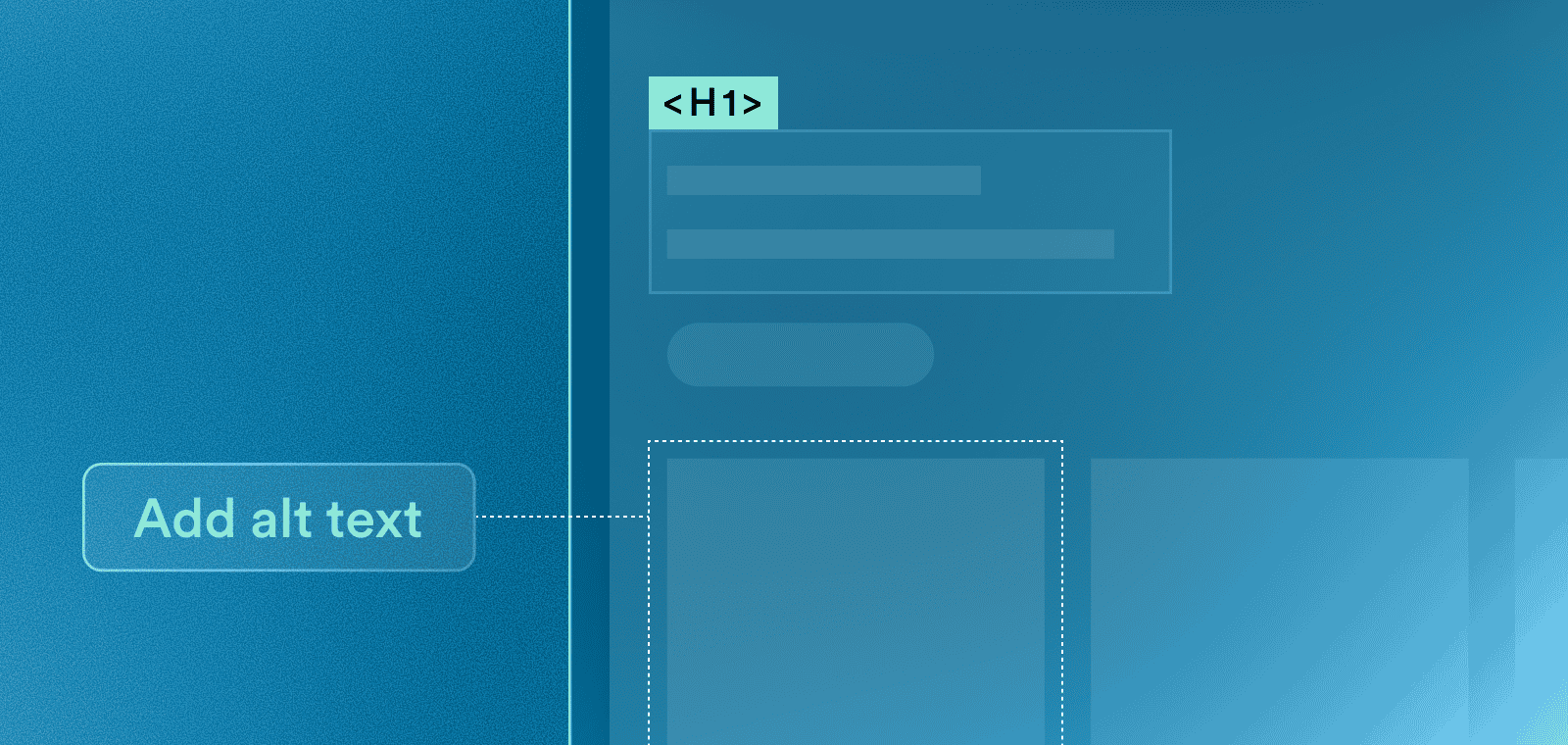
Proper heading hierarchies (H1 through H6) are essential for organizing content so that screen reader users can navigate a page effectively. For AI models, these headers function as a table of contents. A logical heading structure allows the machine to quickly identify the primary topic and understand how different subsections relate to each other. Without these signals, your content appears "flat" to an AI, making it difficult for the model to interpret your primary message or accurately cite your data.
Meaningful alt text for multimodal discovery
Alternative text (alt text) is a short description of an image that helps people with vision impairments understand visual content via screen readers. Today’s multimodal AI models also rely on this metadata to "see" and categorize images. Providing descriptive alt text for product images or infographics ensures that an AI assistant can accurately recommend your brand when a user asks a visual or descriptive question. Without it, your most important visual assets remain invisible to conversational search.
Putting theory to the test: A look inside the "mind" of an LLM
Rather than just talking about theory, let's analyze the way in which Gemini breaks down its own process when presented with an informational query.
When asked how it would search for an answer to the question "Is web accessibility the law?", here is how it explains its "thought process":
"When I search the web to answer your prompt, my goal isn't just to find a keyword match; it is to find the most extractable and reliable block of information. Here is how I evaluate a source:
- I strip the "visual noise": I ignore your brand's colors, font, and sleek animations. I only see the code (HTML).
- I look for "Semantic Landmarks": If your site uses tags like <main> and <article>, I immediately know where the meat of the answer is. If these are missing, I have to guess which text is your answer and which is just a sidebar or an ad.
- I verify the "Hierarchy of Truth": I look at your headers. If I see an H2 that says "Web Accessibility Laws in the US" followed by an H3 that says "The Americans with Disabilities Act (ADA)", I have high confidence that the paragraph below it contains the specific facts I need.
- I evaluate "Answerability": I prefer short, factual paragraphs (40-60 words) that I can easily summarize or quote directly without having to "clean up" the text first."
Bottom line: The markers an AI uses to verify your content are many of the same ones that make a site accessible. When you use semantic HTML and clear heading structures, you aren't just helping screen readers navigate your site—you're providing the "roadmap" that allows AI models to find, trust, and cite your brand as a source of truth.
The future of search: Why an accessible foundation is your greatest AEO advantage
The shift from traditional search engines to AI-powered answer engines is more than a technical update—it is a fundamental change in how your brand is discovered. In this new landscape, "search" is becoming a conversation, and the websites that win are the ones that can be most easily understood by AI agents.
By optimizing your website for the "non-visual user," you maximize its chances of showing up in the conversational search results that are rapidly replacing the standard list of links.
In this new era, your "front door" is no longer a homepage designed purely for human eyes—it is the semantic data and structured code that makes your brand visible and reliable to machines.